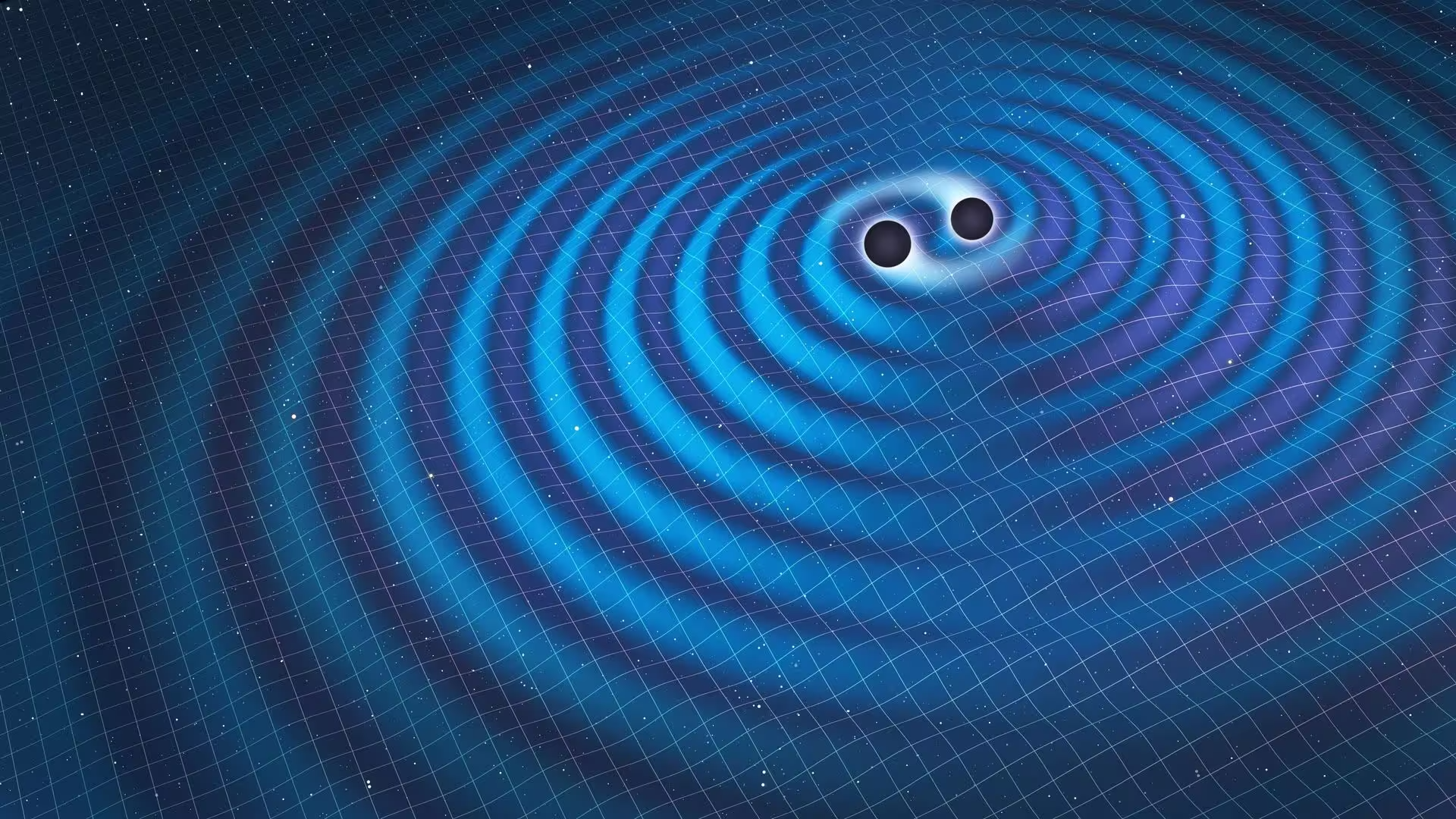
In 1971, Stephen Hawking proposed something remarkable: when two black holes merge, the area of their combined event horizon can never shrink. It was a bold idea, one that mirrored the second law of thermodynamics — only instead of entropy, it was the surface of a black hole that could never decrease.
Now, more than 50 years later, we finally have proof.
On January 14, 2025, Earth was gently rocked by an invisible ripple in space-time. It came from a violent collision between two black holes, over a billion light-years away. The event, dubbed GW250114, wasn’t just any black hole merger. It was the loudest gravitational wave signal we’ve ever received — twice as strong as anything detected before.
A Cosmic Bell Rings Louder Than Ever
When black holes collide, they shake the very fabric of the universe, producing gravitational waves that race across space at the speed of light. Capturing these tiny distortions — thousands of times smaller than an atomic nucleus — is the job of observatories like LIGO in the US, Virgo in Italy, KAGRA in Japan, and GEO600 in Germany. Together, they form the LIGO–Virgo–KAGRA (LVK) collaboration.
But this time, only LIGO was active. Fortunately, its recent upgrades made all the difference.
Compared to 2015 — when LIGO made the first-ever detection of gravitational waves — its sensitivity has now tripled. That boost allowed physicists to observe intricate details of GW250114, especially the final “ringdown” phase of the collision, where the newly formed black hole settles into its final shape.
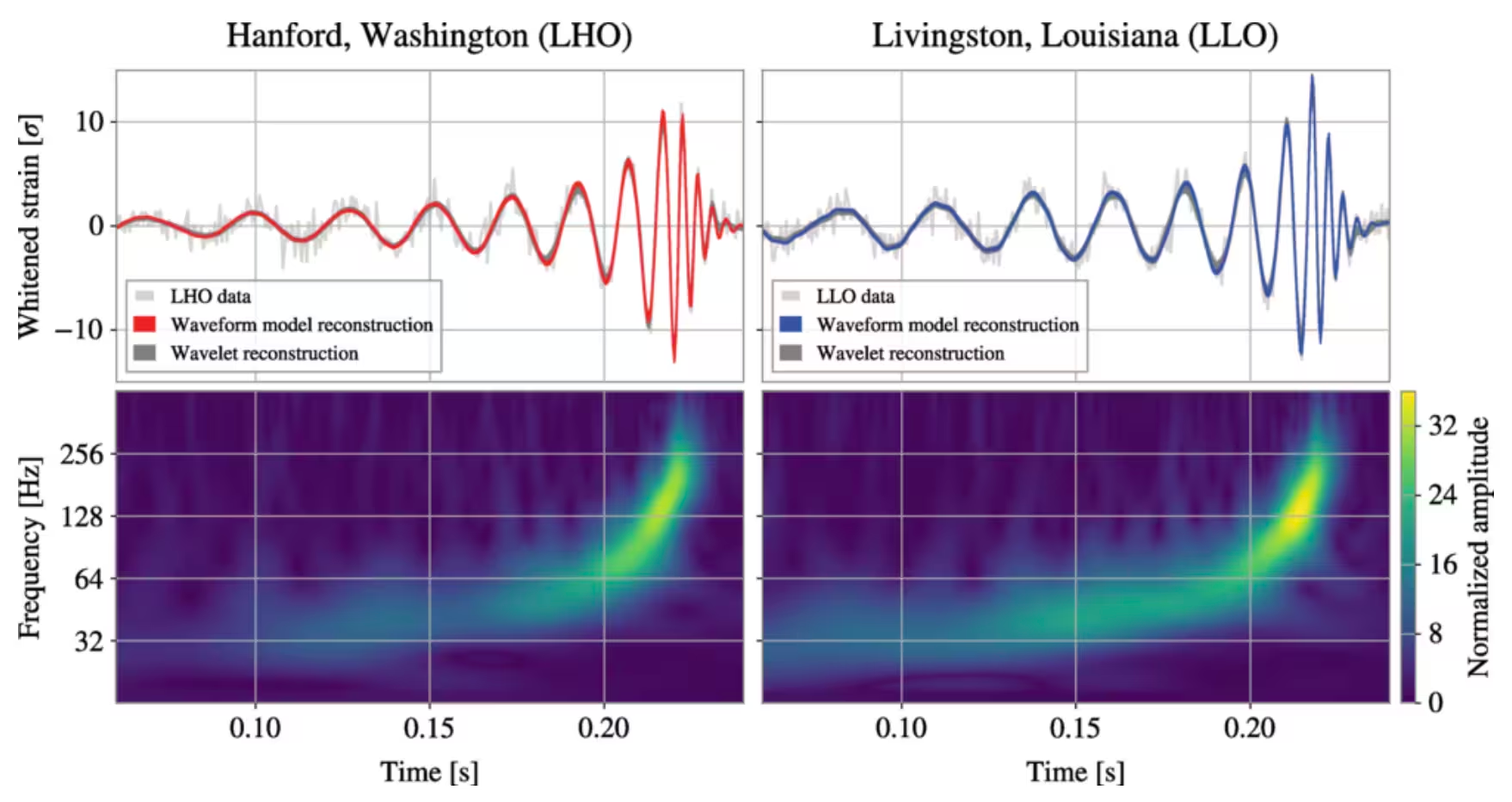
Figure: Data captured by the LIGO detectors during the GW250114 event — Hanford (left) and Livingston (right). The top row compares the raw gravitational wave data (after noise whitening and filtering) with two different reconstructions of the signal: one using Einstein’s equations for merging black holes, and another using a model-independent method based on wavelets. Both reconstructions fall within the 90% confidence interval. The signal, detected on January 14, 2025, peaked dramatically, rising more than 10 standard deviations above the background noise. The bottom panels display time-frequency maps of the data, showing how the frequency of the signal increased — a classic “chirp” — as the two black holes spiraled toward collision. (Credit: Abac et al.)
It’s in this phase — akin to a bell’s final chime — that the size of the event horizon can be estimated. And the results are in: the final black hole’s surface area is larger than the sum of the two that created it. Hawking was right.
99.999% Certainty: The Numbers Don’t Lie
In 2021, an earlier analysis of a black hole merger supported Hawking’s theorem with 95% confidence. But this new event? It delivers a resounding 99.999% certainty.
Why the jump? According to astrophysicist Laura Nuttall from the University of Portsmouth, it’s all about clarity. “The louder the signal, the more we can dig into the nitty-gritty of the physics,” she says. And GW250114 was loud enough to extract unprecedented insights — from energy loss to the subtle overtones of gravitational ringing.
Over the past decade, astronomers have recorded nearly 300 black hole collisions. But none have been this clear. GW250114 is the gold standard.
Not Just Hawking — Kerr Was Right Too
There’s more. The data also confirmed predictions made in the 1960s by mathematician Roy Kerr. His equations describe the most general form of a rotating black hole — defined entirely by just two properties: mass and spin.
GW250114 provided the clearest observational evidence yet that black holes really are that simple. Two black holes with the same mass and spin? They’re mathematically indistinguishable.
This elegantly supports the idea that black holes “have no hair” — they reveal nothing about the details of what fell into them. A truly mind-bending consequence of Einstein’s general relativity.
A Glimpse at Quantum Gravity?
As detectors continue to improve, physicists hope to uncover the seams where general relativity and quantum mechanics begin to unravel — the holy grail of modern physics.
According to Nuttall, we’re not there yet: “So far, the two theories still play nicely together.” But the next big event — maybe one closer to Earth, or even louder than GW250114 — might just expose the first cracks.
Upgrades to LIGO and future observatories are already underway. By 2028, we could be detecting waves sensitive enough to probe the edges of space-time itself — and perhaps uncover evidence for a long-sought theory of quantum gravity.
Until then, one thing is clear: Hawking’s bold intuition, half a century ago, just passed one of its toughest tests yet — thanks to a ripple in the cosmos, and a telescope made of lasers and mirrors.